
Navigating a Shifting Culture: What New Circana Research Means for Restaurants
By Bighouse Graphix /
The food-and-beverage world is no stranger to disruption. The COVID years forced rapid pivots in delivery, takeout, contactless checkout, and more. But even beyond pandemic legacies, consumer behavior is continuing to evolve, especially as more people return to hybrid or full-time office life.
A recent study from Circana, “Emerging Trends: Daypart Disruptions Impacting Consumer Behavior,” uncovers emerging shifts in when, how, and what people eat. Insights that restaurants can lean into to remain relevant and competitive. Circana
Here’s a breakdown of key findings, what they mean for restaurant operators, and actionable ideas you can test in your business.
Key Findings from the Circana Study & Their Implications
Finding 1: Early breakfasts are gaining importance
- Circana reports that 39% of consumers now eat breakfast before 8 a.m., an increase of 5 points since 2020. Circana
Implication for restaurants:
If your operations can stretch earlier, this is a chance to capture a customer who might otherwise default to a convenience store, coffee shop, or making something at home. Think grab-and-go breakfast sandwiches, wraps, parfaits, or even small “breakfast snack” options. The investment to open earlier (or partner with third parties) could pay off by grabbing a share of morning spend.
________________________________________________________
Finding 2: “Snack meals” are rising
- Many consumers favor on-the-go, lighter, snackable items. Circana
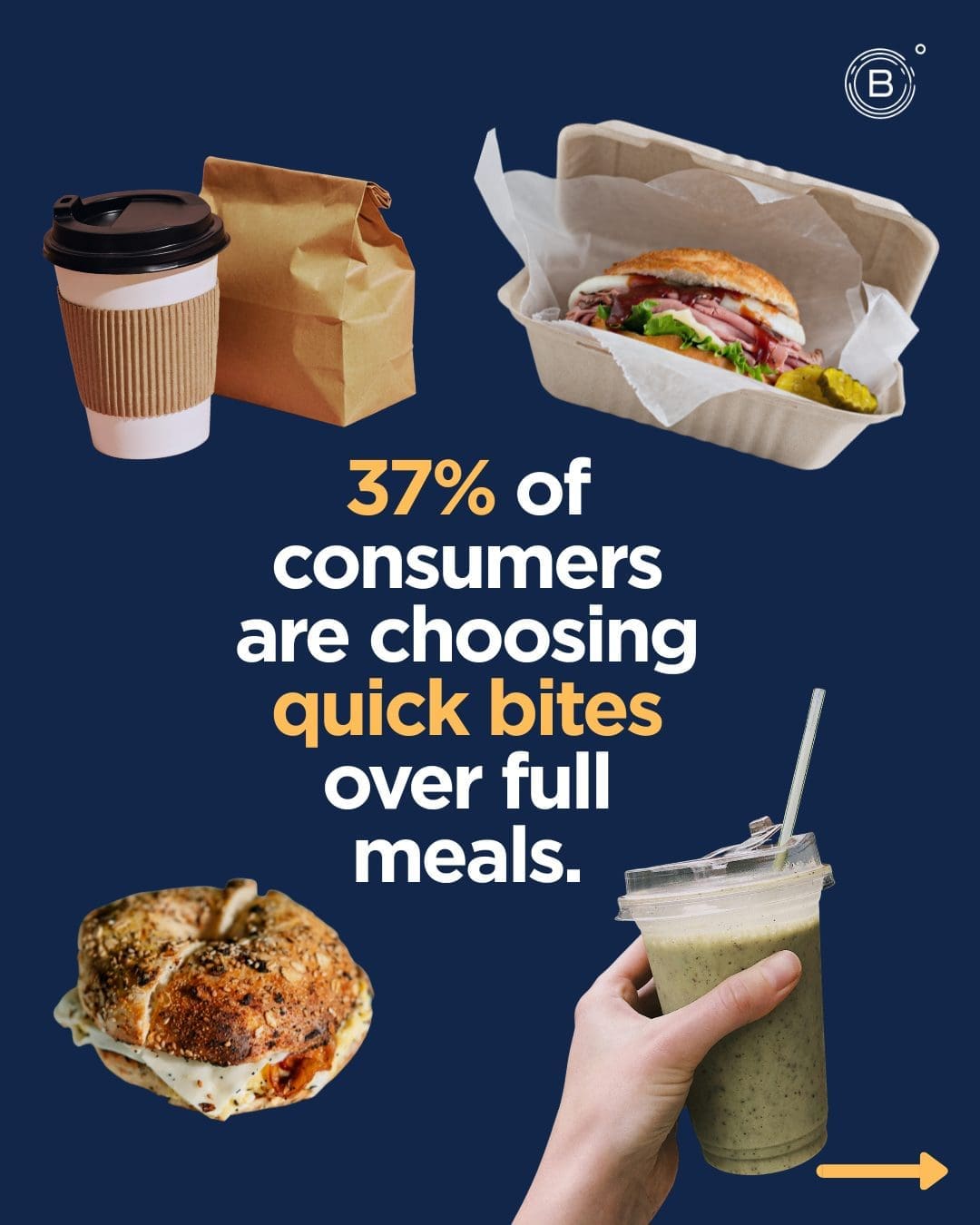
- In 2024, 37% of consumers said they were opting for quick bites instead of “full meals,” up from 29% in 2010. Circana
Implication for restaurants:
You’ll want to rethink both your menu design and service format during midday:
- Menu design: Offer snack-size or shareable portions, mini-bowls, combo “snack plus side” offerings, or items optimized for portability (easy to eat on the go, minimal mess, controlled packaging).
- Service format: Streamline ordering, consider express lanes or digital preorders, and optimize for speed. If a customer is in and out in ten minutes, make that experience seamless.
- Channel expansion: Work with cloud kitchens, ghost kitchens, delivery, or micro-fulfillment pops in office districts to capture “snack-meal” demand even if people aren’t physically entering your dining room.
_______________________________________________________
Finding 3: As office occupancy increases, so does opportunity
- Hybrid work models caused disruption. Fewer people in offices meant fewer typical lunch trips, but as office occupancy climbs again, the opportunity is re-opening. Circana
- Indeed, the study notes that in January & February (2025), white-collar workers made 8% more on-premises morning and lunch visits versus a year prior. Circana
Implications for restaurants:
While lunch may be short, restaurants can still take advantage of the growing demand.
- Partner with corporate buildings for pre-order lunch programs or catering bundles.
- Offer pre-scheduled pickup for office workers to minimize wait times.
- Use geotargeted digital ads (Google, Meta) during 7–9 a.m. and 11 a.m.–1 p.m. near office ZIP codes.
_______________________________________________________
Finding 4: Dinner is increasingly shaped by heat-and-eat or ready-to-eat options
- With more constrained schedules and less desire to cook every night, consumers are turning to options that demand less effort and time. Circana
- Meal kits, prepared meals, “ready to heat” entrées, and packaged add-ons have gained traction. Even consumers who plan to dine at a restaurant may incorporate easier fare into their routines.
Implication for restaurants:
Your evening strategy may benefit from a hybrid model:
- Take-home / ready-to-heat offerings: Offer cold or partially cooked meals that customers can pick up, reheat easily, and complement with sides or finishing touches.
- Family / multi-portion packs: Design meals that serve 2–4 people, encourage repeat picks.
- Subscription or pre-order models: Give regular customers the option to schedule their dinner pickup ahead.
- Cross-merchandising: Pair a fresh side or dessert to go with a packaged meal to maintain connection with your brand.
- Menu flexibility: Adapt your dine-in menu to shorter prep times or shareable items to account for staffing constraints or consumer preferences.
More Strategic Recommendations for Restaurant Owners
Modularize your menu / portions
- Build menu items that can be broken down into smaller, combinable units (e.g. half-portion bowls, sliders, snack packs)
- Use core components (proteins, sauces, sides) interchangeably, so you maintain operational efficiency while offering variety
- Provide à la carte sides or small extras to encourage upsells (a small side + drink to convert a snack into something more)
Optimize for portability & speed
- Reduce packaging complexity (single-hand consumption, spill-resistant containers)
- Use technology (preorder, app ordering, curbside pickup, express lanes) to reduce friction
- Train staff for quick-turn operations and consistency during busy midday windows
Location-aware strategies
- If your restaurant is near business districts, consider pop-up delivery hubs, kiosk stands, catering micro-stations, or static food-truck presence in office-heavy zones
- Partner with local offices to negotiate lunch programs, “employee meal credits,” or delivered snack bundles
- Use data (POS, foot traffic, marketing attribution) to identify which blocks, times, and formats are most profitable, then double down
Marketing & communication adaptation
- Highlight convenience, speed, portability. Explicitly market “snack-meal” options
- Emphasize early breakfast or commuter-friendly fare to capture the 8 a.m. + crowd
- Use segmented messaging: “midday pick-me-up,” “evening made easy,” “grab-before-you-go”
- Offer bundles or subscription incentives (e.g. buy 5 snack packs, get 1 free)
Experiment & iterate fast
- Pilot one new snack / mini-meal offering for a limited period
- Measure sales, customer feedback, operational strain, margin
- Adjust price points, packaging, or promotion based on real data
- Roll out the winners more broadly
_______________________________________________________
What This Means in Practice: Sample Scenarios
- A suburban café could open 30 minutes earlier and introduce pre-packed breakfast burritos or yogurt parfaits for the early crowd
- A midtown lunch spot might strip down its lunch menu to high-margin, single-serve bowls and launch a subscription “snack-lunch of the week” program
- A full-service restaurant could repackage part of its dinner menu into a “heat at home kit” section and promote it heavily in the late afternoon
- An operator having multiple units could turn one kitchen into a “snack / express” hub, while others focus on dine-in, letting each site specialize
________________________________________________________
Final Thoughts
The Circana research makes one thing clear: consumers’ eating patterns are no longer rigid. They’re adapting to lives with more hybrid work schedules, unpredictable breaks, and a desire for convenience without sacrificing quality.
For restaurant owners, the opportunity lies in rethinking when, how much, and in what form food is offered. The demand is there for early breakfasts, snack-style lunches, and flexible evening options. The question is how quickly you can adapt your operations, menu, and marketing to tap into it.